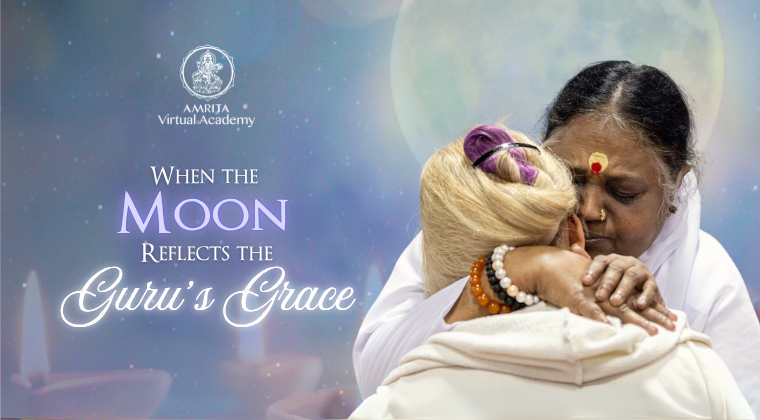
Guru Purnima is a sacred occasion of deep reverence, a day to honor and express gratitude to the Guru—the one who dispels the darkness of ignorance and leads us toward the light of truth. Derived from Sanskrit, gu means “darkness”, and ru means “remover”; thus, the Guru is the remover of darkness.
Celebrated on the full moon day (Purnima) in the Hindu month of Ashadha (June–July), Guru Purnima holds special significance for spiritual seekers. While we may have many teachers throughout life—who guide us in music, science, or language—it is the spiritual Guru, the Satguru, who liberates us from the deep-rooted ignorance of the material world (samsara) and bestows the wisdom of the Self.
Ganesha writing the Mahabharata for Ved Vyasa
This auspicious day also commemorates the birth of Ved Vyasa, the great sage who compiled the Vedas and authored the epic Mahabharata. Hence, it is also known as Vyasa Purnima. The Guru-shishya (teacher-disciple) tradition, deeply embedded in scriptures like the Upanishads and the Bhagavad Gita, is based on this transformative relationship between seeker and guide.
From the nurturing love of our mother, the disciplined teachings of our father, to the intellectual guidance of school teachers—each play a role in our growth. Yet, it is the Satguru alone who purifies the heart and mind, making us ready to receive self-knowledge (Atma Sakshatkaram).
Payasam (sweet pudding) as prasadam (sacred food offering) from Vaju’s course Amrita Prasadam
On Guru Purnima, many observe fasting, offer naivedyam (sacred food offerings), and perform Guru Puja. Dishes like vermicelli payasam, fruits, and sweet curd are shared as prasadam, symbolizing purity and gratitude.
Vaju in the Amrita Prasadam Kitchen at Amritapuri
For us, this day is made even more sacred because of Amma, our beloved Guru. She is the embodiment of unconditional love and wisdom, tirelessly uplifting countless lives. In her presence, we feel profound peace, and in her teachings, we find clarity, courage, and compassion. She has comforted, guided, and transformed lives across the world, a true beacon of divine grace.
As we bow down in reverence, we recall the lines from the Guru Stotram:
“There is no truth beyond the Guru, No penance greater than the Guru, No wisdom higher than the Guru.”
To such a divine being, what can we offer but our tears of gratitude, and our prayer to merge with her holy feet?
Om Namah Shivaya. May this Guru Purnima be a time of reflection, devotion, and the reaffirmation of our path—walking in the light of the Guru’s wisdom.
Thanks to Vaju for her inspiring satsangs for Amrita Prasadam, the Indian cooking classes in the AVA Membership.
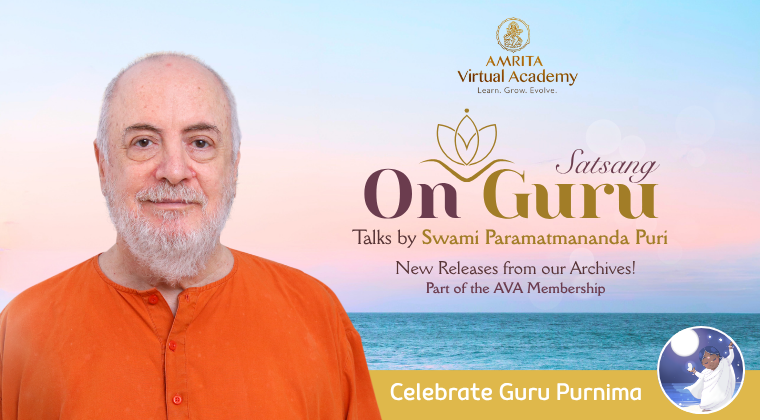
🧘🏼♂️ Newly Released Talks by Swami Paramatmananda Puri: “On Guru” Enjoy this series of digitally remastered talks from Swamiji. These timeless satsangs, lovingly preserved from our archives, continue to inspire and uplift listeners decades after the original cassettes were made. Get access here.
🙏🏼 On-Demand Retreat: “Obeying the Guru” Join Vivek for a powerful retreat exploring the deep significance of surrender and obedience to the Guru. Find out more here.
🍨 Amrita Prasadam Special This Guru Purnima edition of Amrita Prasadam—The Art of Indian Cooking—brings delight with enriching satsangs and festive recipes from Br. Rishi Chaitanya and Vaju. Find out more here.
As an Amrita Virtual Academy member, you have access to more than 80 different courses and retreats in different fields. Discover more about the AVA Membership here. Or sign-up here.
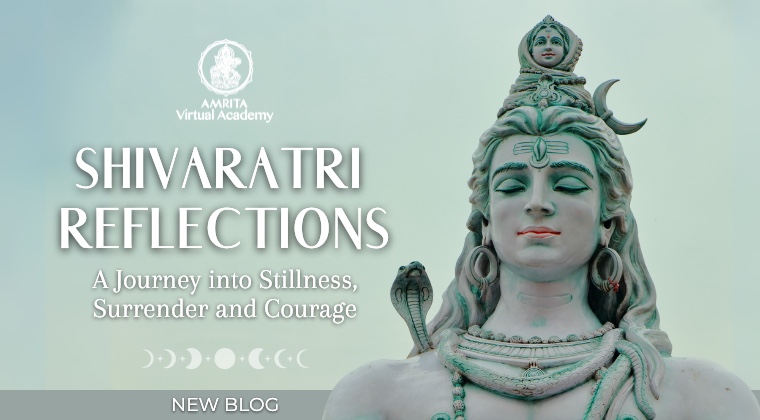
This year, Shivaratri is February 26, 2025. As part of my seva with Amrita Virtual Academy, I was part of the team building the “Celebrating Shivaratri” collection, a series of practices and talks from the AVA Membership which help still the mind and connect students with Lord Shiva. While doing this, it struck me that I had some doubts about Shiva. Who is He? What sort of energy is experienced through Him? What qualities would I nurture if I was closer to Him?
I wasn’t brought up in the tradition of Sanatana Dharma, so I don’t have a natural understanding of these things. But, because Amma places importance on them, I want to understand them better. Since Shivaratri, the ancient nightlong celebration of Shiva, is coming soon, I decided to investigate.
Who is Shiva?
I started my investigation by enjoying the content collection we were selecting for February, and my mind and understanding began to expand. To be honest, I started with the “fun stuff”—the music, yoga, and Mindful Movement classes. Included in the music of the Shivaratri collection are: (1) a Shiva bhajan singalong (bhajans are spiritual/devotional songs usually sung in a call-and-response format), (2) a nostalgic movie of a newly-released, Amma-led bhajan set recorded during a U.S. tour, and (3) Br. Ramanandamrita Chaitanya’s moving session on bhajans as meditation.
Following the music, I enjoyed the priceless hatha yoga class based on the sun salutation, and the profound Mindful Movement class. Both the yoga and Mindful Movement teachers are phenomenal. I started to get an intuitive sense that Shiva is about how inner stillness, focus, and devotion connects us to something Absolute and beyond words.
Looking at the other treasures in the collection, I began to see more deeply and tangibly how a connection with Shiva would foster stillness, courage, and a relationship with the Absolute.
What Amma Says About Shiva
Amma has spoken extensively about Shiva, and it would be impossible to summarize much in this short blog, but I was reminded of her words on Shivaratri in 2020. Amma talked about life being like a river that we can only see part of. If we live on the banks of a river, we can only see whatever is in our visual field, and it is not correct to believe that we see the whole river—we cannot see its whole length, or source, or mouth. Amma said:
“Life is a beginning-less and endless river, constantly flowing and changing. The human mind and intellect cannot measure or know its depth or length. This mystery, itself, is Shiva. Our mind is finite and filled with fragmented thoughts and feelings. Shiva, or God, is one and infinite.” —Amma (Sri Mata Amritanandamayi Devi)
Drawing together the impressions I’d gathered already, and combining them with this incredible quote, I dove deeper. I thought, “What if I relax the idea that what I see/feel/hear is all there is? What if I relax beyond these senses and feelings into this mystery that Amma is talking about? What then? Will I touch the infinite mystery?”
Shiva and the Absolute
Inspired by my initial course exploration, and by Amma’s quote, I decided to listen to Swami
Paramatmananda Puri’s talk “Becoming the Absolute”. In this Satsang, Swamiji tells so many wonderful stories, but one that really stopped me was about a rich man. The rich man falls deeply in love with a spiritual teacher, a guru, feeling certain that if he dedicates himself fully, he will achieve knowledge of the Absolute.
This man has only ever been able to connect to the Absolute through a particular image of God. He had built an elaborate room in his home to house and focus on this image. The teacher tells him to disassemble it, and he obeys, even throwing away the bricks the room was built with. This kind of hard-to-understand request from a teacher is a theme that runs deeply through Western and Eastern mystic traditions.
After this, he loses all his riches, and ends up cutting and selling grass to support his family. Yet, he is still certain that if he obeys his guru, he will attain his goal. This paradoxical certainty is another common theme. Perhaps this kind of story is a way of showing the power of dedication to a mystery beyond logic.
After about 6 months, a messenger comes with a letter from his teacher, but the man must pay 20 rupees for the delivery (around 25 cents). The man has no such money, but his wife and daughter sell their remaining jewelry to raise the money, and the letter is finally given to him. The man is overcome with emotion that he has received a personal letter from his revered teacher. He holds the letter to his heart in such full reverence and concentration that immediately his mind stops and he is filled with awareness of the Absolute.
In the end, innocent faith and total surrender resulted in the grace of knowledge being given by the master.
The story made me feel the power of full devotion and trust. To use Amma’s analogy, what the man did, in my understanding, was to look beyond the river he could see, and fall into the mystery beyond, touching the Absolute. What led him there was love for, and full courage and trust in his teacher, made complete through grace.
Perhaps this mystery, and the willingness to let go of my logical mind is what I will aim for on Shivaratri night!
I want to end with a beautiful and somewhat startling example that illustrates how Shiva is not some distant, snake-wearing deity, but a presence that can be experienced even by animals.
Amma has such profound love for everything in creation. In her early days, during periods of intense spiritual practices, she would forget to eat or sleep, and animals and birds would bring her packets of food to eat. Amma’s deep love for all beings can be seen when she kisses tiny birds, feeds baby squirrels, cuddles her dog, or caresses plants.
While many of us have deep-seated fears of certain animals, Amma sees the oneness of all creation and only expresses love. Nature is attracted to this loving stillness and responds by reflecting it back, becoming docile and tame in Amma’s presence.
This love has been seen to extend even to snakes, who respond to it as innocently as a puppy or baby bird. For example, there have been times with Amma, when a snake has come close, crawled up her arm, and wound itself around the hair atop her head. The snake then perches there while Amma meditates, exactly like the depictions of Shiva in statues, where snakes ornament his neck and/or head. I saw a video of Amma with one of the snakes a couple of times. It’s quite remarkable.
While I don’t yet feel like I’ve fully answered my own questions, the process of wondering has brought me to feel closer to both Shiva and Amma. Hopefully anyone reading this blog may also be inspired to explore, in their own personal way. I am absolutely certain that wondering and contemplating on Shiva, Amma, or any deity, brings a deeper relationship with them that is quite fruitful. I feel like I’ve imbibed much of the content in the February Shiva collection and have definitely made progress.
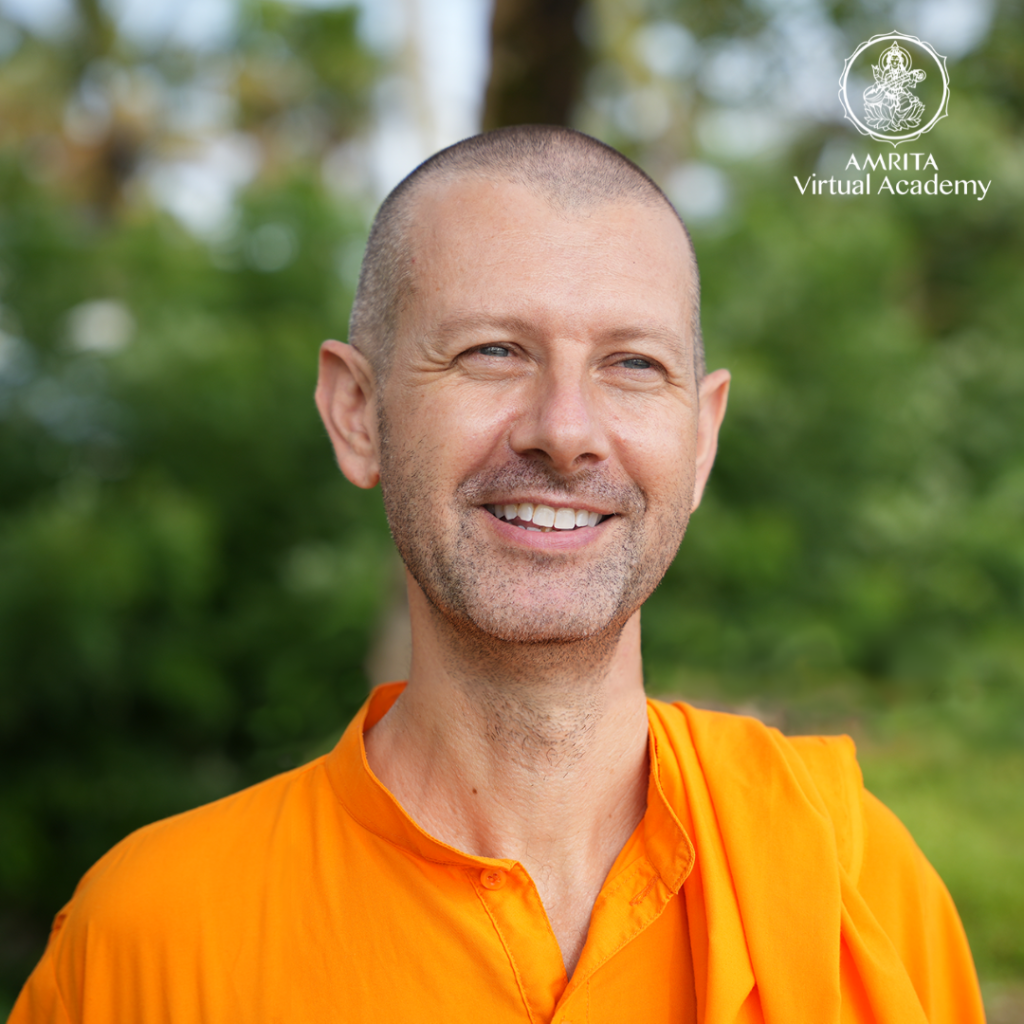
In January, Amrita Virtual Academy will start the scriptural study series Knowledge of the Truth: An Introduction to Vedanta on the text Tattvabodha with classes led by Br. Sachinmayamrita Chaitanya. I’m excited for it, partly because I’ve been able to hear a few of his previous talks before on other topics, and partly because this is a text that provides a framework for all of Vedantic thought.
The first time I got to hear him talk was at the beginning of the Amrita Gita course. I had no idea how thirsty I was for information on the Indian scriptures until I heard this talk. I had wondered vaguely: “What is the relationship between the Upanishads and Vedanta? Are the Upanishads part of the Vedas, or separate? Was the Bhagavad Gita written before or later than the Upanishads? What do you study? Where do you start? How are they all related?” When I heard his talk, I hung onto every word and relistened with my notebook in hand, a few days later. It was profound, precise, and so full of devotion I wept a couple of times.
I know his series on Tattvabodha will be at least as good as his previous lectures, and needed in ways I’m not even aware of yet. Every bit of extra understanding I receive is absorbed deeply into me in ways that are hard to explain. I’ve seen more and more that I need to study the scriptures, to properly absorb the things Amma teaches us, as well as to properly absorb the things that happen to me in my life and how I respond to them. This understanding is intellectual and far beyond the intellect at the same time.
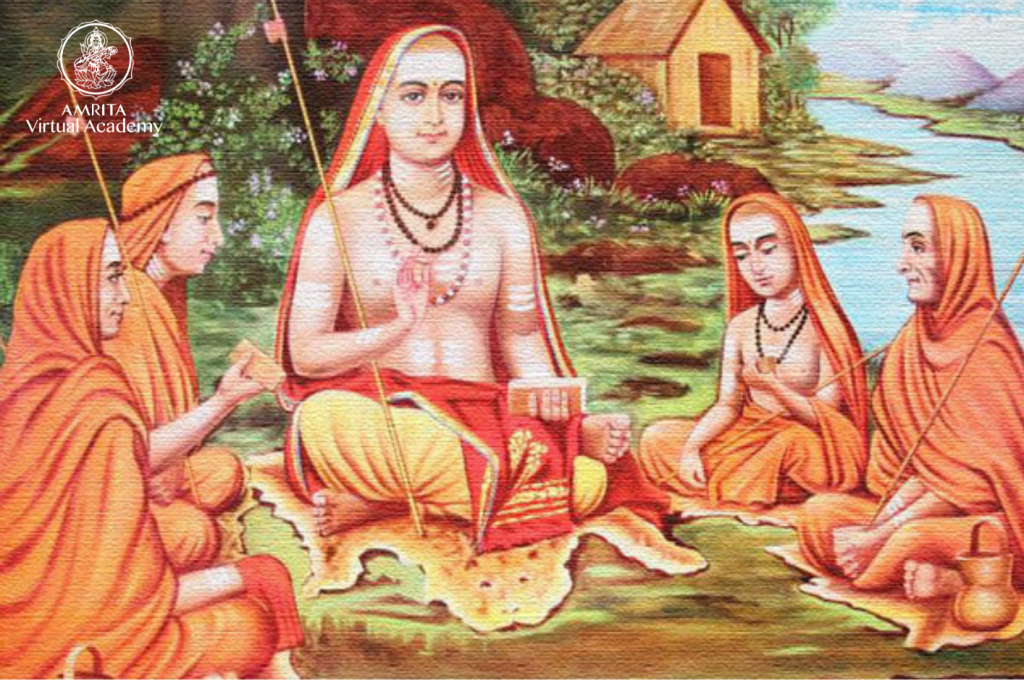
In his talk, Br. Sachinmayamritaji mentioned that the Sanskrit word Upanishad is composed of three syllables: “upa“, to come near; “ni“, to have focus, dedication, sincerity; and “shad“, to sit. Br. Sachinmayamritaji also mentioned that “shad” means to destroy, as in destruction of ignorance. It is yummy to imagine a group of dedicated students sitting by a sacred river or mountain with the teacher and this is in fact the surface meaning. Part of the deeper meaning is to let go of assumptions, leaving the cup of the mind as empty as possible, to take in and be nourished by the wisdom of the guru.
Contemplating this lecture gave rise to other dimensions beyond the concept of “upa”, or sitting down near the guru. It has begun to mean to me that I’ve prepared my mind to receive Amma’s teachings. To come close is not to be next to Amma’s body, but to be close enough in my mind and heart to receive what she is giving. Part of this preparation is to be versed at least a little bit in scriptures. Versing in them makes me alert to things Amma does and says.
For example, during a recent satsang the brahmacharini (nun) who was speaking, expressed that Amma had once teased her a little about her accent, saying that Amma had trouble understanding what she was saying. The brahmacharini said it made her afraid that Amma might even ask her to leave the ashram over it. By the way she chanted Amma’s Dhyayamo Shlokah at the beginning of the talk, it appeared to me that she was very self-conscious and self-judging about her speaking and singing voice. Of course Amma would never banish someone from the ashram because of their accent! Somehow during the interaction, Amma caused her to spontaneously sing part of a bhajan, forgetting her self-consciousness completely. It was beautiful, and seemed to me to heal the bramacharini’s lifelong fears, at least for a few moments in Amma’s divine presence.
There are too many scriptures discussing fear to even begin to describe here, but I’ll mention a couple. Bhagavad Gita Chapter 16, Verses 1–3 lists fearlessness as one of the virtues of people who have realized their divinity. The Brihadaranyaka Upanishad (1. 4. 2) talks about how realizing the nature of our true self is a vital step in transcending fear. Several Upanishads discuss fear as a consequence of the false belief in ourselves as separate from the unity, from God.
Watching that interaction, I saw Amma take the brahmacharini’s deep fear and turn it on its head. Those moments of fearlessness surely caused the brahmacharini to experience life without fear for a few precious moments, allowing her to experience the truth underlying it. For me, knowing a little about the scriptural take on fear, was part of what helped me see what it was Amma was doing, at least from my perspective. The other thing that helped me appreciate the interaction was my attitude toward Amma—of drawing close by having learned that there is a deeper meaning to everything she does and says.
Without that knowledge, it could have looked like a self-conscious brahmacharini spoke, sang a little, had a quick conversation with Amma, and then it was time for bhajans. But because I knew a little, and also have come to understand that everything Amma does and says is a living scripture, I was able to clearly grasp more depth than I would have been able to otherwise. This is a tiny bit of the power of knowing a little about the scriptures, and therefore, some of what we could gain from participating in this Tattvabodha course.
Coming back to Br. Sachinmayamritaji’s satsang from the Amrita Gita course, there was a part of his talk that made me weep. He described how the guru is like a sculptor who sees the finished art in a block of wood or metal and then removes what is NOT the art. This is something many of us have heard before, but the way Br. Sachinmayamritaji put it was so full of devotion on top of his precision in language. The guru sees us as divine, as the guru itself, and lovingly works to remove whatever in us is not a reflection of this. I have come to see that knowledge of the scriptures allows me to collaborate internally with the guru in this process. Knowledge of the scriptures allows me to see where I’m going and what is in the way.
“Knowledge of the scriptures allows me to see where I’m going and what is in the way.”
But I cannot study the scriptures haphazardly and still be effective. Hearing a great line here or there out of context isn’t as helpful or impactful as a structured study. The Tattvabodha provides an essential framework for all of Vedantic thought. It answers deep questions about who we are, those questions many of us have had since childhood.
In Tattvabodha, the author discusses the creation, composition and characteristics of our mind, intellect, memory and ego. He talks about the three different types of bodies we possess during waking, dreams and sound sleep. Along the way, he shows that these things are not what we actually are, and how our reality is beyond all bodies and definitions.
The series of talks from Br. Sachinmayamritaji will clarify the Tattvabodha and prepare the groundwork and a framework for receiving that.
Thanks to Kamala for sharing her inspiring experience with Amrita Virtual Academy. We encourage you to try out the upcoming new course Knowledge of the Truth with Brahmachari Sachinmayamritya Chaitanya, starting on January 5, here. It is a self-paced course with weekly commentaries on the scripture as well as regular live sessions (with replay access) for doubt clearing.
Amrita Virtual Academy offers a range of scriptural classes, from Bhagavad Gita to Narada Bhakti Sutras. See more here.
As an Amrita Virtual Academy member, you have access to more than 80 different courses and retreats in different fields.
Discover more about the AVA Membership here. Or sign-up here.
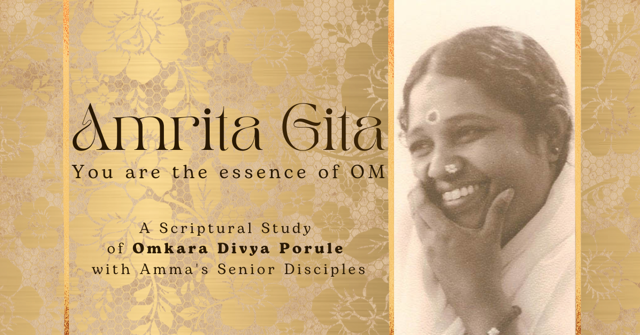
I’m excited to share more with you about Amrita Gita, one of Amrita Virtual Academy’s most recent and valuable gemstones, amongst its online courses. This spiritual course dives deeply into Amma’s teachings, which are shared and made available through the poetic compilations of Swami Turiyamritananda Puri.
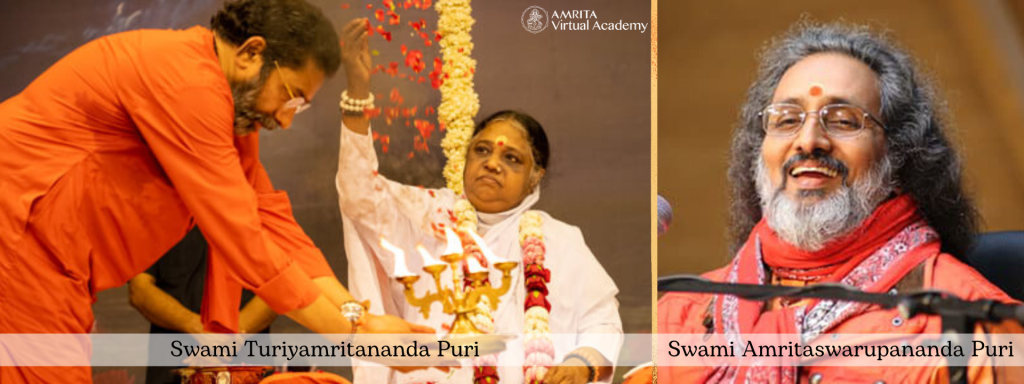
Since Swami Turiyamritananda Puri had been the first disciple to be with Amma, and was with her since his teens, he heard many early conversations between Amma and her devotees. He realized the precious pearls of wisdom that emerged should be preserved and shared with the world. The result became a collection of poetic verses named, Amrita Dhara.
Soon after, Swami Amritaswarupananda Puri, Amma’s most senior disciple, tuned the verses into a wondrous bhajan for Amma’s 32nd birthday. The bhajan was named Omkara Divya Porule and contains 32 verses. Since then, Swami Turiyamritananda Puri has offered a new collection of “Amrita Dhara” verses each year for Amma’s birthday, containing the same number of verses as Amma’s years on the planet, in her current form
The verses from the first Omkara Divya Porule are currently being reflected on by the Ashram residents and visitors through the “Amrita Dhara Yajna” satsangs (spiritual talks), currently occurring daily, during Amma’s evening programs in Amritapuri, India, which are also streamed online with an on-demand replay available soon after.
In Amrita Virtual Academy’s course, Amrita Gita, a number of Amma’s swamis share their thoughts on the different verses of Amrita Dhara / Omkara Divya Porule through offering satsangs and Q&A sessions. They also share wondrous stories from the early days with Amma. The course also provides the opportunity to view some vintage video footage, satsangs, and stories from the Amritapuri archives, so you, too, can indulge in feeling what it was like to be with Amma in the early days.
That was what captured me, as I listened to the first satsang in the course by Swami Turiyamritananda Puri; I loved how he speaks of stories from the past, and how Amma talked in parables. I also appreciated how Swamiji felt the need and call to preserve Amma’s wisdom, and turn her words into poems, so that people could more easily digest the essence of her teachings.
I felt awe for the wisdom he has, to be able to transform those words from Amma into a more easy-to-understand, yet elegant language. I also thought about what a great heart he must possess to feel the need to serve the world in this way. It made me feel grateful and in awe, wishing no one to miss out on this rare and precious, online spiritual course!
Several of the students in the course have also expressed what the online classes have meant to them so far, and how the course has inspired, transformed and uplifted them in their spiritual practices, as well as their daily life. Here are are some sharings from a couple of those voices:
Karen LaVigne (USA) shares:
The Swamis’ explanations and insights are so beautiful that I’m often brought to tears. The one inspiration that stays with me always is to keep Amma’s image in my mind, so she becomes my eyes/vision, ears, speech, smell, taste and touch… all my senses. I wish I had the words to express my gratitude for this practice.
Thank you to Karen for sharing her beautiful experience. What an inspiration for all of us, to keep Amma in our minds, close to our heart at all times… and to finally reach that point where we are established in that final experience that Amma is—indeed the consciousness behind our senses and mind.
Our next student, Madhurima, also feels the power of this online spiritual course, and explains how the teachings help her to slowly transform her thoughts…
Madhurima (Canada) shares:
“This ‘course’ has been such a lovely addition to my daily sadhana. And, I’ve followed the recommendation that the verses be sung at the end of arcana each morning… And, I know Verse 1 by heart now… Thank you. It is all so good… and I know I am imbibing the ‘wisdom’, as well… little by little in my daily life I find myself ‘correcting a thought’ with something that I have learned from the verses or the satsangs…”
Each month, one Swami provides three 20-minute commentaries on the verses in addition to a one-hour live Q&A. The final live session of the Amrita Gita online course is currently scheduled to be a closing ceremony in October (see schedule); but, you can still join anytime, and participate at your own pace. The replay videos are normally uploaded within a week of the live classes to the Amrita Virtual Academy website and all of the satsang commentaries are on-demand.
Don’t miss out on this precious opportunity to dive more deeply into Amma’s teachings. Amrita Gita is part of the AVA Membership. Become a member, and join Amrita Gita now! As a member, you get full access to 60+ online courses and retreats.




 I started my investigation by enjoying the content collection we were selecting for February, and my mind and understanding began to expand. To be honest, I started with the “fun stuff”—the music, yoga, and Mindful Movement classes. Included in the music of the Shivaratri collection are: (1) a Shiva bhajan singalong (bhajans are spiritual/devotional songs usually sung in a call-and-response format), (2) a nostalgic movie of a newly-released, Amma-led bhajan set recorded during a U.S. tour, and (3) Br. Ramanan
 Following the music, I enjoyed the priceless hatha yoga class based on the sun salutation,
  Amma has spoken extensively about Shiva, and it would be impossible to summarize much in this short blog, but I was reminded of her words on Shivaratri in 2020. Amma talked about life being like a river that we can only see part of. If we live on the banks of a river, we can only see whatever is in our visual field, and it is not correct to believe that we see the whole river—we cannot see its whole length, or source, or mouth. Amma said:
 Inspired by my initial course exploration, and by Amma’s quote, I decided to listen to Swami